

Melbourne buyers usually come across two main ways to buy property auction and private sale.
Both can work. Both can also create risk if the buyer is not prepared.
The method of sale affects how quickly you need to act, how much room you have to negotiate, whether you can include conditions, and how much pressure you may feel during the process.
For first-time property investors, Melbourne investors and buyers looking for a second purchase, the question is not simply auction vs private sale. The better question is: which method gives you the best chance of buying the right property at the right price, without taking on unnecessary risk?
What Is a Private Sale?
A private sale is when a property is listed with an asking price or price range, and buyers make offers through the selling agent.
The vendor can accept, reject or negotiate the offer. The buyer may also be able to include conditions, such as finance approval, building inspection, pest inspection or preferred settlement terms.
In Victoria, private sales of residential and small rural property generally have a cooling-off period of three clear business days. Consumer Affairs Victoria states that the cooling-off period starts from the date the buyer signs the contract, not when the seller signs it.
This does not mean buyers should sign casually. Legal, finance and building checks should still happen before signing where possible. However, private sale often gives buyers more room to slow the process down and negotiate terms.
What Is an Auction?
An auction is a public sale where buyers bid against each other, usually on a set auction day. If the bidding reaches the vendor’s reserve price, the highest bidder may secure the property.
Auction buying is common in Melbourne, especially for houses, townhouses and well-located properties in competitive suburbs.
The main issue for buyers is that auction contracts are usually unconditional. Consumer Affairs Victoria advises that if an offer is accepted less than three clear business days before auction, there is no cooling-off period. It also states buyers should decide their limit before auction and get independent expert help on legal, finance and building matters before bidding.
That means most of the due diligence needs to be done before auction day.
Auction vs Private Sale: Key Differences for Buyers
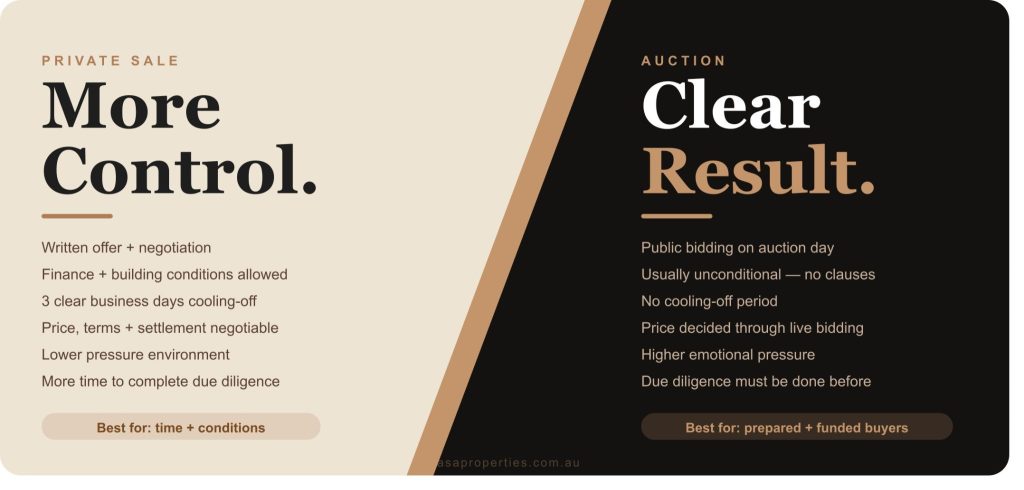
| Area | Private Sale | Auction |
| Buying process | Written offer and negotiation | Public bidding |
| Pressure level | Usually lower | Often higher |
| Conditions | May allow finance, building or pest clauses | Usually unconditional |
| Cooling-off | Usually three clear business days, with exceptions | No cooling-off period |
| Negotiation style | Price, terms and settlement can be negotiated | Price is decided through bidding |
| Speed | Can allow more time | Often decided on auction day |
| Buyer risk | Lower if conditions are included | Higher if due diligence is incomplete |
| Best suited to | Buyers needing time and conditions | Buyers who are prepared, funded and disciplined |
Benefits of Buying Through Private Sale
Private sale can suit buyers who want more control and time.
This can be helpful for first-time investors who need to confirm finance, check rental yield, review the contract and understand whether the property fits their strategy.
Private sale may suit buyers who:
- Need finance approval before committing
- Want building or pest inspection conditions
- Prefer negotiation over public bidding
- Need time to check rental returns
- Want to negotiate settlement timing
- Are buying a second property and need settlement to align with equity release
- Want to compare the property against recent sales before making a firm decision
For a portfolio builder, private sale can provide more flexibility. The buyer may be able to negotiate terms that support cash flow, finance timing and the next investment step.
Risks of Buying Through Private Sale
Private sale is not risk-free.
A vendor can reject your offer, delay the decision or use another buyer’s offer to create urgency. The asking price may not reflect the vendor’s true expectation, and some properties still sell quickly if competition is strong.
Private sale buyers should be careful with:
- Relying too heavily on the advertised price
- Waiting too long in a competitive suburb
- Making offers without comparable sales evidence
- Ignoring contract terms
- Assuming cooling-off solves every risk
- Underestimating building or owners corporation issues
- Overpaying because another buyer is interested
Private sale gives buyers more room to negotiate, but it still requires discipline.
Benefits of Buying at Auction
Auction can work well when the buyer is prepared.
The main benefit is that the process is transparent on the day. You can see who is bidding, how the price is moving and whether the property is likely to sell.
Auction may suit buyers who:
- Have finance confidence
- Have completed contract review
- Have checked the Section 32
- Have arranged building and pest checks if needed
- Know the property’s fair value
- Can stay calm under pressure
- Have a strict walk-away price
- Are buying in suburbs where quality stock often goes to auction
For Melbourne investors, auction can be useful when a property strongly fits the brief and the research has already been completed before auction day.
Risks of Buying at Auction
Auction risk comes from speed, pressure and emotion.
Buyers can be pulled beyond their budget because they do not want to lose the property. Some rely too heavily on the price guide and then feel shocked when the bidding moves higher. Others skip due diligence because they assume the competition means the property must be sound.
Auction buyers should watch for:
- Emotional overbidding
- Low or unclear price expectations
- Incomplete contract review
- No finance clause
- No cooling-off period
- Valuation risk after purchase
- Building defects
- Owners corporation issues
- Settlement pressure
- Deposit readiness
This matters even more for investors. A property that looks exciting at auction may still be a poor investment if the rent, holding costs or resale demand do not support the purchase.
Private Sale vs Public Auction for Portfolio Builders
For buyers looking at a second property or building a portfolio, the method of sale should be assessed against the investment strategy.
A private sale may be better when the buyer needs time to assess rental yield, cash flow, finance structure and the impact on future borrowing capacity.
An auction may be suitable when the buyer has already completed due diligence, understands fair market value and is ready to act quickly.
Portfolio buyers should ask:
- Does this property support the next purchase?
- Will the rental return help with holding costs?
- Will the settlement date work with finance and equity access?
- Is the price supported by comparable sales?
- Is there enough buffer if interest rates or costs change?
- Does the property type suit long-term demand?
- Will buying this property limit future borrowing capacity?
The sales method matters, but the investment fit matters more.
Which Method Suits Which Buyer?
Private sale may suit buyers who want more time, more control and the ability to include conditions.
Auction may suit buyers who are fully prepared, financially ready and comfortable making a firm decision on the day.
| Buyer Situation | Better Fit |
| First-time investor needing finance confidence | Private sale |
| Buyer who wants building or pest conditions | Private sale |
| Investor needing settlement flexibility | Private sale |
| Buyer with full due diligence completed | Auction or private sale |
| Buyer who gets emotional under pressure | Private sale may be safer |
| Experienced buyer with a strict bidding limit | Auction can work |
| Portfolio builder assessing cash flow | Private sale may allow more review time |
There is no perfect method. The better method is the one that matches your preparation, finance position and buying strategy.
How a Buyer’s Agent Can Help
A buyer’s agent in bendigo can help buyers approach both private sale and auction with more structure.
For private sale, a buyer’s agent can help with:
- Offer strategy
- Price negotiation
- Contract timing
- Comparable sales review
- Settlement terms
- Due diligence coordination
For auction, a buyer’s agent can help with:
- Fair value assessment
- Bidding strategy
- Walk-away price discipline
- Pre-auction negotiation
- Risk review before auction day
- Reducing emotional overbidding
For first-time investors, second-property buyers and portfolio builders, this support can be valuable because the buyer’s agent helps separate the property’s actual value from the pressure of the sales process.
Final Thoughts
There is no universal winner between private sale and auction.
Private sale usually gives buyers more room to negotiate, include conditions and manage risk. Auction can offer a clear result on the day, but it requires stronger preparation, finance confidence and emotional discipline.
For Melbourne buyers, the best option depends on the property, competition, contract terms, finance position and long-term investment goal.
The sales method matters, but the strategy matters more.
FAQs
Q. What is the difference between auction and private sale?
A. An auction involves public bidding on a set date. A private sale involves buyers making offers through the selling agent, usually with more room for negotiation and conditions.
Q. Is private sale better than auction for buyers?
A. Private sale can be better for buyers who want more time, more control and the ability to include conditions such as finance, building or pest inspections.
Q. Is auction better than private sale?
A. Auction can be better for buyers who are fully prepared, have completed due diligence and can stay disciplined during bidding.
Q. Is auction risky for first-time investors?
A. Yes, auction can be risky for first-time investors because contracts are usually unconditional, there is no cooling-off period and bidding pressure can lead to overpaying.
Q. Can I include a finance clause in a private sale?
A. Yes, buyers may be able to negotiate a finance clause in a private sale, but the vendor must agree to the condition.
Q. Can I include a finance clause at auction?
A. Usually no. Auction purchases are generally unconditional unless the vendor agrees to different terms before auction.
Q. Is there a cooling-off period after auction in Victoria?
A. No. Consumer Affairs Victoria advises that buyers do not get a cooling-off period when buying at auction.
Q. Is there a cooling-off period for private sales in Victoria?
A. Yes. Most private sales of residential and small rural property in Victoria have a cooling-off period of three clear business days, although exceptions apply.
Q. Should portfolio builders buy through private sale or auction?
A. Portfolio builders may prefer private sale when they need time to review cash flow, rental yield and finance structure. Auction can still work if all due diligence is complete and the property strongly fits the strategy.
Q. What should I check before bidding at auction?
A. Before bidding, check finance, contract terms, Section 32, building condition, comparable sales, deposit requirements and your absolute walk-away price.
Q. Can a buyer’s agent help with auction bidding?
A. Yes. A buyer’s agent can assess fair value, set a bidding limit, plan auction strategy and reduce the risk of emotional overbidding.
Q. Can a buyer’s agent help with private sale negotiation?
A. Yes. A buyer’s agent can review comparable sales, shape the offer strategy, negotiate terms and help the buyer avoid overpaying.