

Buying property is exciting, but negotiation is where many buyers lose money without realising it.
A buyer may find the right home, attend inspections, arrange finance and feel ready to make an offer. But one wrong move during negotiation can push the price higher, weaken their position or cause them to miss out completely.
The biggest issue is that most buyers negotiate emotionally. They focus on the property they want, while the selling agent focuses on getting the best result for the vendor. This is where Common Negotiation Mistakes for Buyers can become expensive.
A strong negotiation is not about being aggressive. It is about preparation, timing, market understanding and knowing when to push, pause or walk away.
1. Showing Too Much Emotion Too Early
One of the most common mistakes buyers make is showing the agent how much they love the property.
Simple comments like “this is perfect for us”, “we have been looking for months” or “we can really see ourselves living here” may feel harmless. But they can tell the selling agent that you are emotionally attached.
Once an agent knows you are highly interested, they may use that information to create urgency or push your budget higher.
This does not mean you should act cold or rude. It simply means you should stay calm, polite and measured. Ask practical questions, review the details and avoid giving away too much too early.
2. Making An Offer Without Understanding Market Value
A property’s asking price is not always its real value. Some properties are priced low to attract more buyers. Others are priced high to test the market.
Many buyers make offers based on the advertised range instead of recent comparable sales. This can lead to overpaying or making an offer that is too weak to be taken seriously.
Before negotiating, buyers should look at similar properties that have sold recently in the same suburb. Focus on land size, condition, location, bedroom count, property type and sale date.
A buyer agent can help assess whether the price expectation is realistic or inflated. This gives you a stronger position before you speak numbers.
3. Revealing Your Full Budget
Telling the selling agent your maximum budget can quickly weaken your negotiation position.
If your maximum budget is $950,000 and the agent knows this, it becomes difficult to negotiate at $910,000 or $920,000. The agent may keep pushing because they know you have more room.
Buyers often reveal their budget when they are trying to appear serious. But being serious does not mean showing all your cards.
You can still communicate that you are ready to proceed without giving away your absolute limit. Keep your budget private and negotiate based on market value, not emotion.
4. Waiting Too Long In A Competitive Market
Some buyers wait too long because they are hoping the price will drop. This can work in a slower market, but it can backfire when a property has strong demand.
If several buyers are interested, waiting too long may give someone else the chance to make a strong offer and secure the property first.
Good negotiation is about timing. Sometimes it is better to move early with a clear, well-supported offer. Other times, it is better to wait and see how the campaign develops.
The mistake is using the same approach for every property. Each property needs its own negotiation strategy.
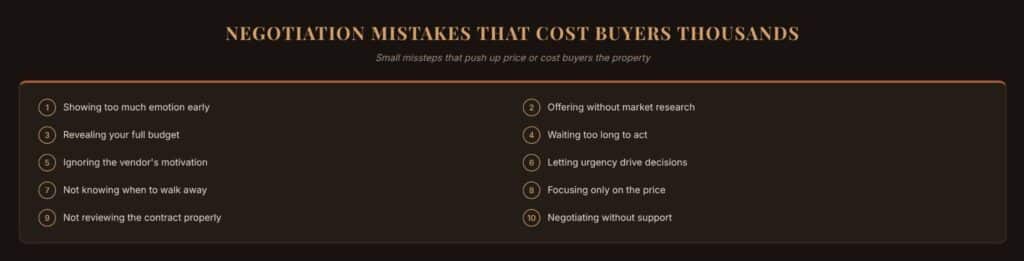
5. Ignoring The Vendor’s Motivation
Price is important, but it is not the only part of a negotiation.
Some vendors want a long settlement. Some want a quick sale. Some are trying to line up their next purchase. Others may prefer fewer conditions or a cleaner contract.
Buyers who only focus on price may miss other ways to make their offer more appealing.
For example, a buyer who can offer a flexible settlement may have an advantage over a higher offer with difficult conditions. Understanding what matters to the vendor can help you negotiate more effectively.
A buyer advocate can help ask the right questions and structure an offer that is attractive without overpaying.
6. Letting Urgency Control The Decision
Selling agents often use urgency because it works.
You may hear phrases like “we have another interested buyer”, “the vendor wants a decision today” or “this will not last long”. Sometimes this is true. Sometimes it is part of the sales process.
The mistake is reacting too quickly without checking the facts.
Before increasing your offer, ask what has changed. Is there a written offer? Has the vendor rejected your current offer? Are there other conditions involved?
Urgency should not replace due diligence. Buyers should stay calm and make decisions based on evidence, not pressure.
7. Not Knowing When To Walk Away
One of the most expensive negotiation mistakes is chasing a property beyond its value.
This usually happens when buyers have missed out before. They feel tired, frustrated and worried they will not find another suitable property. That emotion can lead to overpaying.
Before making an offer, buyers should decide their walk-away price. This should be based on comparable sales, borrowing capacity, repair costs and long-term plans.
If the price goes beyond that point, stepping back may be the smarter decision.
Walking away is not losing. Sometimes it is the decision that protects you from years of financial stress.
8. Focusing Only On The Purchase Price
A property can look like a good deal on price but still become expensive after settlement.
Buyers should also consider building issues, pest problems, owners corporation fees, planning restrictions, renovation costs, insurance and future resale appeal.
A lower purchase price does not always mean better value. If the property needs major work or has limited buyer demand, it may cost more in the long run.
This is especially important for first-home buyers and investors. First-home buyers need to avoid hidden costs that affect affordability. Investors need to understand whether the property will support rental income and long-term growth.
9. Not Reviewing The Contract Properly
Some buyers focus so much on the offer amount that they overlook the contract.
This can be risky. The contract may include special conditions, settlement terms, zoning details, easements, owners corporation information or other issues that affect the property.
Buyers should always have the contract reviewed by a qualified conveyancer or solicitor before making an unconditional offer.
Negotiation is not only about price. It is also about protecting your position legally and financially.
10. Trying To Negotiate Without Support
Many buyers negotiate only once or twice in their life. Selling agents negotiate every week.
That experience gap can make a big difference. Agents understand buyer behaviour, urgency, price anchoring and competitive tension. Buyers can easily feel pressured or uncertain.
Working with a buyer agent Victoria buyers trust can help level the field. A buyer agent can research value, speak with agents, review opportunities, negotiate strategically and help buyers avoid emotional decisions.
This support can be especially useful when buying in a competitive suburb or when you are unsure whether the property is worth the asking price.
Victoria-Based Negotiation Examples
In Victoria, many buyers lose money because they do not adjust their negotiation strategy to the type of sale.
At a Melbourne auction, a buyer may continue bidding past their limit because they feel pressure from the crowd or worry they will miss out again. This can lead to paying more than the property is worth, especially if the final price is driven by emotion rather than comparable sales.
In a private sale, the mistake can be different. A buyer may offer too much too early because they want to secure the property before anyone else sees it. If the vendor was already open to negotiation, this can cost the buyer thousands.
Regional and outer-suburban Victorian markets can also require a different approach. A property in Geelong, Ballarat, Bendigo or Melbourne’s growth corridors may have different demand levels, buyer competition and vendor expectations compared with inner Melbourne.
Using the same negotiation approach everywhere can lead to poor decisions. This is where local support can help. A buyer agent can assess the property, review comparable sales, understand the campaign type and guide buyers on when to act, when to negotiate and when to walk away.
Common Negotiation Mistakes To Avoid As Buyers
The most important mistakes to avoid are showing too much emotion, revealing your full budget, ignoring market value, rushing under pressure and not knowing your walk-away price.
Buyers should also avoid making offers without research, ignoring contract risks and assuming the agent is working in their best interest.
A selling agent works for the vendor. Their job is to get the best outcome for the seller. As a buyer, you need your own strategy.
Final Thoughts
Property negotiation is not about winning for the sake of winning. It is about buying the right property at the right price, with the right terms.
For first-home buyers, strong negotiation can help protect your budget and reduce stress. For investors, it can improve your numbers from the start and support better long-term returns.
The best buyers are prepared before they make an offer. They understand market value, know their limits and avoid getting pulled into emotional decisions.
If you are preparing to buy and want support with negotiation, contact us before making your next offer.
FAQs
Q. What are the most common negotiation mistakes for buyers?
A. The most common mistakes include showing too much emotion, revealing the full budget, making offers without market research, rushing under pressure and not having a clear walk-away price.
Q. What are the common negotiation mistakes to avoid as buyers?
A. The key mistakes to avoid as buyers are overreacting to pressure, offering without comparable sales, ignoring the contract, bidding beyond budget and assuming the selling agent is working for you.
Q. Should I make the first offer on a property?
A. It depends on the property and market conditions. In some cases, making the first offer can help you control the conversation. In other cases, waiting may give you more information. The right move depends on demand, vendor motivation and comparable sales.
Q. Can a buyer agent help with negotiation?
A. Yes. A buyer agent can help research property value, speak with selling agents, structure offers and negotiate on your behalf. This can be helpful if you are unsure how much to offer or how to handle pressure.
Q. Is the lowest offer always the best starting point?
A. No. An offer that is too low can weaken your credibility, especially in a competitive market. A strong offer should be based on research, not just trying to get the lowest price.
How do I avoid overpaying for a property?
Review recent comparable sales, understand the property’s condition, check the contract, set a walk-away price and avoid making decisions based only on emotion.