
Buying property in Melbourne often starts with one practical question: should you buy an apartment or a house?
For first-time buyers, the decision usually comes down to affordability, lifestyle and how safely they can enter the market. For investors, the focus is rental demand, capital growth, holding costs and resale value.
So, is it better to buy an apartment or house in Melbourne? The answer depends on your budget, goals and the quality of the property. Houses often offer stronger long-term growth because of land value, while apartments can offer a lower entry price, better location access and stronger rental yield in the right suburb.
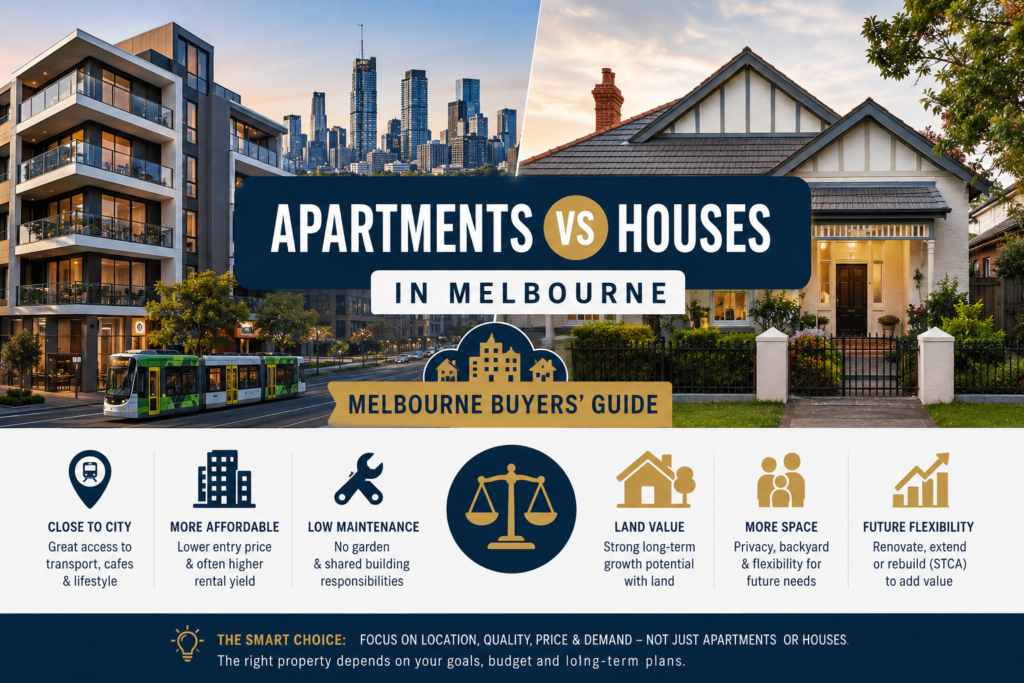
This Apartments vs Houses in Melbourne Melbourne Buyers’ Guide explains the key differences so both first-time buyers and investors can make a clearer decision.
Why Houses Appeal To First-Time Buyers
A house is often the goal for many first-time buyers. It usually offers more space, privacy, parking, outdoor areas and flexibility for future life changes.
The biggest advantage is land. In many Melbourne suburbs, land is what drives long-term value. A house may also give you more control to renovate, extend or improve the property over time, subject to council rules and budget.
For buyers planning to start a family, work from home or stay in one place for longer, a house can provide comfort and stability. It may also appeal to future buyers who want school access, backyard space and a quieter street.
The challenge is affordability. Houses usually need a larger deposit and higher loan repayments. They can also come with more maintenance and repair costs. First-time buyers may need to move further from the city, which can affect lifestyle and commute time.
A house may be right if it fits your budget and sits in a suburb with good transport, schools, parks, shops and long-term demand.
Why Apartments Appeal To First-Time Buyers
Apartments can be a realistic starting point for first-time buyers in Melbourne. They are often more affordable than houses and may allow buyers to live closer to the city, work, cafes, public transport and lifestyle areas.
This matters because buying a home is not only about future value. It is also about how well the property suits your daily life. A good apartment in a connected suburb can sometimes be a better choice than a house in a location that feels too far away.
Apartments can also be easier to maintain. There is usually no garden to manage, and shared building areas are handled through the owners corporation.
However, buyers need to be careful. Small floorplans, poor natural light, noisy locations, high owners corporation fees, cladding concerns or too many similar units in one building can affect lifestyle and resale value.
A quality apartment should have a functional layout, good light, strong local demand and clear reasons why future buyers or tenants would want it.
Why Houses Appeal To Investors
For investors, houses are often attractive because they include land. Over time, land in well-located Melbourne suburbs can become more valuable, especially where supply is limited and demand stays strong.
Houses may also attract families who want stability, schools, outdoor areas and more space. These tenants may stay longer, which can reduce vacancy risk and leasing costs.
Another benefit is future flexibility. Investors may be able to renovate, extend, rebuild or improve the property later, depending on planning rules and feasibility.
The trade-off is cost. Houses are usually more expensive to buy and may deliver lower rental yield than apartments. Repairs, garden maintenance and holding costs can also be higher.
A house may suit investors who are focused on long-term capital growth and can manage the cash flow comfortably.
Why Apartments Appeal To Investors
Apartments can work well for investors who want a lower purchase price and stronger rental yield. In the right location, apartments can appeal to students, professionals, hospital workers, city workers and downsizers.
They can also help investors buy into suburbs where houses are out of reach. This can be useful when the area has strong employment access, transport, shopping, dining and lifestyle appeal.
The main risk is supply. Large apartment buildings with many similar units can make it harder to stand out when leasing or reselling. High owners corporation fees can also reduce your net return.
Investors should look closely at the building, floorplan, natural light, noise, parking, storage, tenant demand and future supply nearby.
What Should Buyers Compare?
The decision should not be based only on “house” or “apartment”. It should be based on asset quality.
First-time buyers should ask: can I afford this without financial stress? Will I enjoy living here? Will the property suit me for the next few years?
Investors should ask: what is the rental demand? What is the vacancy risk? Are the holding costs manageable? Is there future growth potential?
A house is not always better just because it has land. An apartment is not always weaker because it has strata fees. The right property depends on location, condition, price and demand.
When A House May Be Better
A house may be better for first-time buyers who want more space, stability and future flexibility. For investors, it may be stronger when the suburb has family demand, limited supply, schools, transport and good long-term fundamentals.
The key is not to buy any house at any price. A poor-quality house in the wrong location can still underperform.
When An Apartment May Be Better
An apartment may be better for first-time buyers who want affordability, location and convenience. For investors, it may work when rental demand is strong and the numbers make sense.
Locations near train stations, universities, hospitals, employment hubs and lifestyle precincts can be worth considering. The key is quality, not just a cheaper price.
How A Buyer Agent Can Help
Choosing between an apartment and a house can be difficult because the right answer changes by suburb, property type and buyer goal.
A Buyer Agent can help first-time buyers understand which suburbs match their budget and which properties may have better resale appeal.
For investors, a buyer agent melbourne buyers trust can help compare rental yield, growth potential, vacancy risk, owners corporation costs and negotiation opportunities.
Final Verdict
There is no single winner between apartments and houses in Melbourne.
For first-time buyers, the better choice is the property that suits your budget, lifestyle and future plans without creating financial pressure. For investors, the better choice is the property that balances rental demand, holding costs, capital growth potential and resale appeal.
Houses often provide land value, space and long-term flexibility. Apartments can provide affordability, convenience and stronger rental yield in the right location.
Before buying, compare the property itself, not just the category. If you are unsure which option suits your goals, contact us for guidance before making your next move.
FAQs
Q. Is it better to buy an apartment or house in Melbourne?
A. It depends on your goal. A house may suit buyers looking for land, space and long-term growth. An apartment may suit buyers wanting affordability, convenience and stronger rental yield.
Q. Are apartments good for first-time buyers in Melbourne?
A. Yes. Apartments can be a practical entry point, especially in well-connected suburbs. Buyers should avoid poor-quality buildings, high fees and oversupplied locations.
Q. Are houses better for investors?
A. Houses can be better for long-term capital growth because of land value, but they usually cost more and may have lower rental yield. Investors should check the full numbers first.
Q. Should I use a buyer agent before buying?
A. A buyer agent can help compare options, assess risks, review value and support negotiation. This can be useful for both first-time buyers and investors.